A Good Scrub, or Just a Wash?
A Deep-Dive into Whether the Economics Still Hold Water
For years scrubbers were shipping’s favorite shortcut. Install the system, burn cheaper high sulfur fuel oil, pocket the spread, and let the investment pay for itself at impressive speed. Today that story reads a little differently. Fuel spreads have lost some of their swagger, environmental expectations continue to climb, and new fuel technologies are tugging at the industry’s attention. Scrubbers can still earn their keep, but the debate now has more texture. It begs the question of whether or not the easy money phase is behind us.
The first hurdle is still the same: cost. Scrubber installations remain a major capital decision with the price tag not softening with time. Larger newbuild vessels’ cost to install typically lands somewhere between $2-$3 million, with retrofits often rising into the $3-$5 million range. MRs tend to command a slightly cheaper scrubber price point, ~$1.3 million, despite burning far less fuel than their larger counterparts. None of these figures include off-hire days, the frustration of missing a strong freight market, or the steady drip of lifetime maintenance that every Owner learns to respect.
This creates an interesting contrast. A Korean-built VLCC today costs around $128 million, while an MR costs closer to $49-$50 million. On a percentage basis, the scale of the investment feels very different in each case. $2 million to scrubber-fit a VLCC at the yard barely moves the needle, but $1.3 million on an MR commands more attention, and Owners often pause before committing.
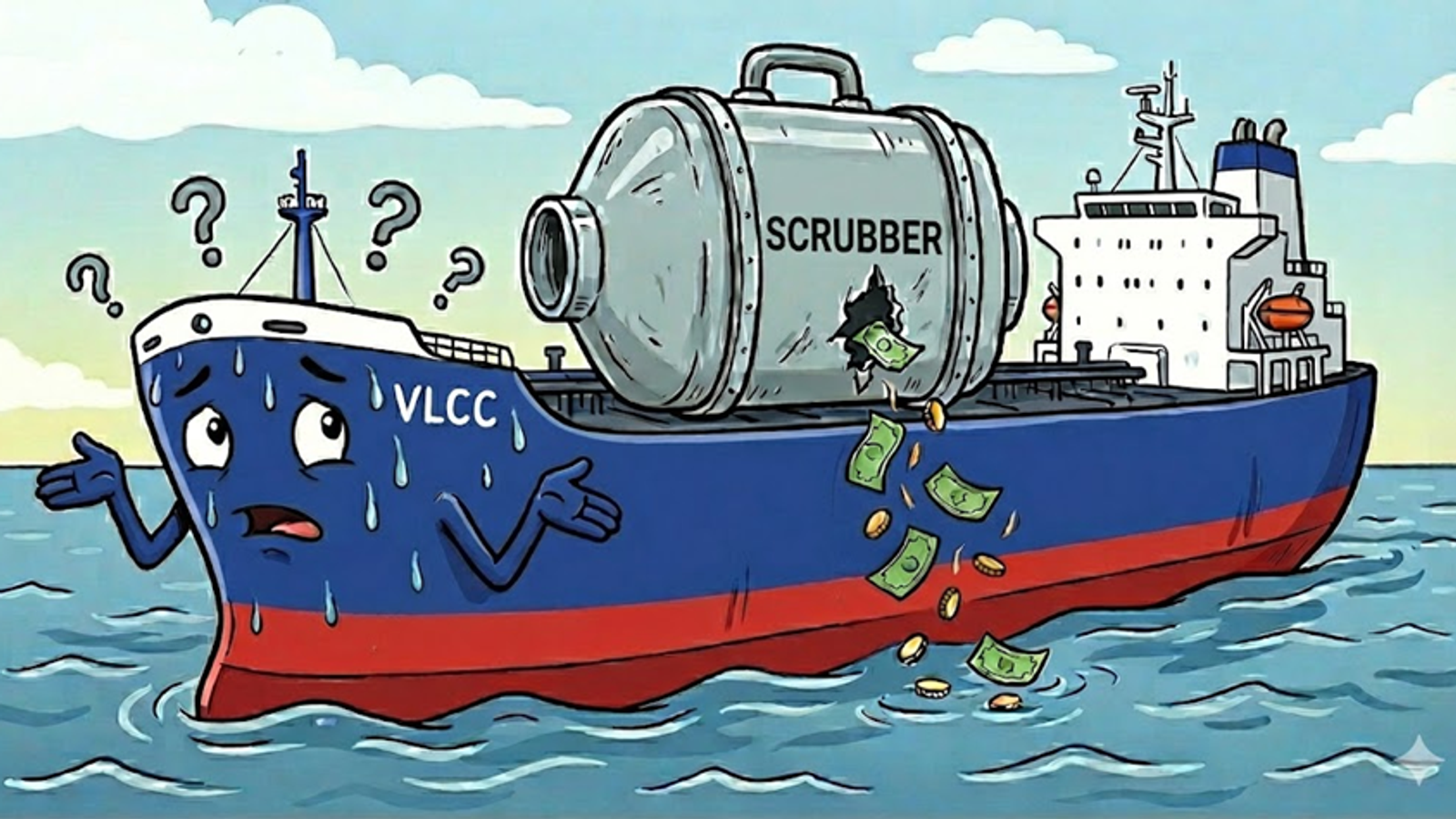
And then there is the hardware itself. A scrubber is not an abstract financial concept. It is real steel, real volume, real weight, and real complexity. Like every other piece of machinery onboard, it requires a stock of spare parts and is exposed to weather, ship movement, salt corrosion and other realities of ocean life, making regular maintenance mandatory. When the fuel spread is generous, the system feels like a smart competitive edge. When the spread tightens, it could start to feel like luggage a vessel must haul around long after the trip is over.
Utilization is another part of the story, and an important one. A VLCC trading long haul might log about 250 days at sea each year. Other classes follow their own patterns, but the logic is the same. The more a ship moves, the more fuel it burns and the more value a scrubber can unlock. Ships that linger at anchor, wait for cargo, or shuffle between short legs see the advantage fade. Scrubbers also draw a small amount of additional power, often 1-2% of main engine load. They burn the same fuel as the vessel, so a ship running on HSFO should expect the scrubber to do the same. The impact is modest, but it trims the savings all the same.
The time charter market offers a candid look at how scrubbers are valued today. Historically, scrubber-fitted tonnage earned a clear premium. Charterers loved the arithmetic. Cheaper bunkers meant lower voyage costs and a vessel that paid for itself in real time. Those premiums still exist, often in the range of 1,500 to 5,000 dollars per day, but they breathe with the market. When spreads narrow, so does enthusiasm. When freight is tight and charterers are focused on securing tonnage rather than optimizing bunker consumption, the premium can shrink again. In strong spreads, however, scrubber-fitted vessels quietly return to their role as the clever choice.
Environmental concerns create yet another layer. Scrubbers remove sulfur from exhaust gases, which is undeniably beneficial. Open loop systems, however, discharge washwater back into the sea, complete with the pollutants they captured. More and more ports, like those in California, are restricting or prohibiting this practice. Closed loop and hybrid systems avoid washwater discharge but come with higher complexity, more equipment and more operating energy. None of the systems address carbon emissions. In a world marching steadily toward decarbonization, scrubbers solve yesterday’s regulatory issue without contributing much to tomorrow’s.
With the differential between VLSFO and HSFO narrow, it may make less sense for many Owners to pursue retrofits at this point in the cycle. The payback becomes too distant. Yet for an Owner looking to order a newbuild VLCC, Suezmax or Aframax, a scrubber can still serve as a form of future-proofing, a way to position the asset more attractively for Charterers in case spreads widen again. For older ships, a scrubber can even provide a new lease on life by helping them compete with younger, more efficient tonnage that would otherwise outperform them on operating cost.
So, the question Owners face now is not whether scrubbers work. They do. The question is whether they are still worth the steel, the space, and the spend. And that answer hinges almost entirely on the fuel spread. Wide spreads still deliver meaningful payback. Narrow ones stretch the horizon and invite Owners to consider whether their capital should aim at other technologies, efficiencies, or future fuel pathways. Scrubbers have not lost their relevance, but their aura has shifted. They are no longer the obvious choice that they were in the early days of IMO 2020.They are now a strategic choice, best suited for certain ships on certain routes with certain trading patterns. They can still create value, but the calculus requires more nuance and more caution than before.
As the industry transitions, the real question becomes this: Is the scrubber still a smart tool for the future of the fleet? Is it an insurance policy for Owners with deep pockets to hedge against potential oil price surges? Or is it a souvenir from the glory days of the spread, kept onboard long after the economics have disembarked?
Time will tell.