We’ve been talking about chokepoints a lot lately, and for good reason. Since March, the tanker market has been dealing with a constrained Strait of Hormuz. Saudi Arabia pushed more crude west to Yanbu to get around it. Then Houthi pressure in the Red Sea compromised that route too. The workaround needed a workaround. Freight responded accordingly. But there’s a bigger point here. The world has a lot more chokepoints than we think.
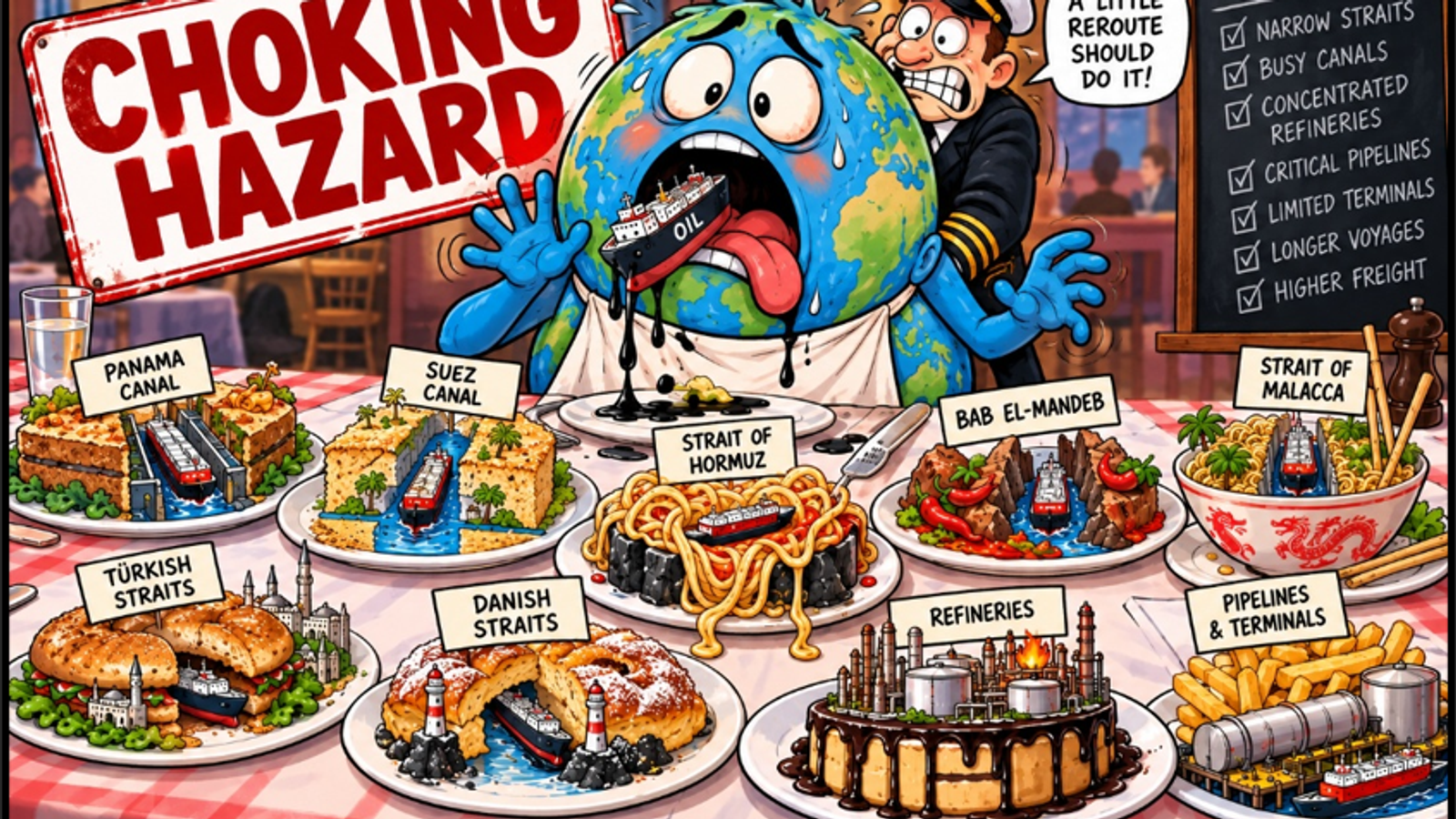
Hormuz gets the headlines because the numbers are enormous. More than 20 million barrels per day of oil regularly moved through the Strait before the current disruption and by the second quarter, that fell to 4.9 million barrels per day. But Hormuz isn’t unique. Look at the map. Malacca. Bab el-Mandeb. Suez. Panama. The Bosphorus and Dardanelles. The Danish Straits. Huge volumes of energy trade move every day through narrow pieces of geography that barely register on a globe.
We’ve spent decades diversifying where oil comes from. We haven’t done nearly as much to diversify the places it has to pass through. And that matters because a chokepoint doesn’t have to fully close to become a problem. It just has to become unreliable enough that people start behaving differently. Owners rethink voyages. Charterers source different barrels. Insurers reprice risk. Ships reposition. Routes lengthen. Arbitrages disappear and reappear somewhere else. The geography doesn’t change. The economics do.
Take Malacca. Before this year’s disruptions, about 23 million barrels per day of crude and petroleum liquids were moving through the Strait. That’s more than Hormuz. Sitting between Malaysia, Indonesia and Singapore, it's one of the main arteries between Middle Eastern supply and Asian demand, which is why it fell to 16.6 million in the second quarter. Choke Hormuz and Malacca starts coughing too. Chokepoints work in series.
There are alternatives. While Sunda may be too shallow for the big ships, Lombok and Makassar offer a deep-water detour. But another route isn’t necessarily an equal route. If even part of Malacca’s traffic has to go another way, the question isn’t whether Asia gets its oil. It’s how long the trip takes.
Now move west. The Bosphorus and Dardanelles are the maritime doorway between the Black Sea and the Mediterranean. In Q2, roughly 4 million barrels per day of oil moved through the Turkish Straits, and the Bosphorus is less than half a nautical mile wide at its narrowest point. There isn’t another one next door. If passage becomes materially harder, Black Sea barrels don’t magically reappear in the Med. Replacement barrels may come from farther away. And for tanker markets, distance is the whole game. A barrel replaced by another barrel may look neutral on an oil balance sheet. It isn’t neutral on a shipping one.
Keep going north and you find one most people don’t think much about: the Danish Straits. They probably should. The Great Belt and Øresund connect the Baltic with the North Sea. Roughly 4.7 million barrels per day of oil moved through the Danish Straits in the second quarter of this year. That’s more than the Turkish Straits and more than Panama.
There’s an interesting bit of history here too. For centuries, Denmark actually charged ships to pass through Øresund through the Sound Dues. We’re not suggesting Denmark is about to reinstall a toll booth. Modern treaties and international navigation law make that comparison much more complicated. But the history makes the point nicely. Geography creates leverage. Legal transit rights and commercially reliable transit aren’t always the same thing. A passage only has to become difficult enough that the market starts pricing the difficulty.
Then there’s Suez. We already know what happens when Suez becomes less attractive. You go around Africa. Problem solved. Sort of. The Cape of Good Hope carried roughly 9.4 million barrels per day of oil in the second quarter of this year. It’s become shipping’s pressure-release valve. But the Cape charges its toll in miles. Longer voyages mean more fuel, more time and more ships tied up doing the same work. That’s why a chokepoint can be good for freight even if the oil keeps moving. Inefficiency is demand.
Panama showed us another version of the same thing. No geopolitical confrontation required. A drought can do it. Reduce capacity, increase waiting times or make transit expensive enough and shipping adjusts. Wait. Pay. Or go around. A shortcut only has value while it remains a shortcut.
And maybe we’ve been defining chokepoints too narrowly because some of the most important ones don’t appear on a nautical chart at all. They have distillation towers.
The Wall Street Journal recently called refineries the main chokepoint for global energy supplies, and the argument should sound familiar to anyone watching tanker markets. Over the past decade, major refining investments in the Persian Gulf and Russia shifted more of the world’s diesel supply toward those regions. At the same time, refinery closures in the U.S. and Europe reduced capacity elsewhere. Now those concentrated sources of refined products are under pressure, and suddenly the world is discovering that having enough crude oil isn’t the same thing as having enough diesel. That’s a chokepoint too.
If a refinery goes offline, crude moves somewhere else to be processed, and products travel farther to reach the market that needs them. VLCCs, Suezmaxes and Aframaxes move the crude. MRs, LR1s and LR2s move the products. A refinery disruption can create shipping demand on both sides of the barrel.
That's where the U.S. comes in. America isn't just a crude producer. It's a crude exporter, a major refiner and a major product exporter. If Middle Eastern crude gets harder to access, U.S. barrels can help fill the gap. If overseas refining capacity gets squeezed, U.S. products can help fill that gap too, as long as Washington lets them. With diesel above $6 a gallon, there are calls in Congress to ban diesel exports. That would be a chokepoint drawn with a pen instead of a coastline. And when the replacement barrel or product has to travel farther than what it replaced, tankers pick up the miles.
That may be the biggest lesson in all of this. We tend to think about energy security in terms of supply. How much oil exists? How much refining capacity exists? Maybe we should spend more time thinking about access. Can the barrel get out? Can the ship get through? Can the refinery process it? Can the product get where it needs to go? Every one of those questions contains a chokepoint. The global oil market looks incredibly diversified until you trace the physical path of a barrel from the wellhead to the gas tank. Then it starts looking surprisingly narrow.
The world isn’t short chokepoints. We’re just getting better at noticing them.